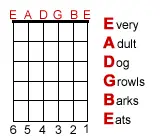
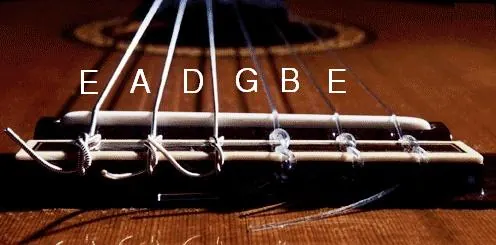
To find notes on a guitar, start with the open string names: E, A, D, G, B, E from thickest to thinnest. Each fret raises the pitch by one half step.
You do not need to memorize the whole fretboard in one sitting. Learn the open strings, learn how sharps and flats work, then use the 12th fret as the point where the pattern repeats.
Start With Open Strings
Standard tuning gives you these open strings:
- 6th string: E
- 5th string: A
- 4th string: D
- 3rd string: G
- 2nd string: B
- 1st string: E
The low E string and high E string share the same note name, but they are different octaves. That is why beginner diagrams often show E at both edges of the fretboard.
The quickest memory anchor is to say the strings out loud from thickest to thinnest before you practice: E, A, D, G, B, E. Then say them the other direction: E, B, G, D, A, E. Lessons and chord diagrams may use either note names or string numbers, so both directions help.
Move One Fret At A Time
If an open string is E, the first fret is F, the second fret is F sharp or G flat, and the third fret is G. The same pattern applies to every string.
The musical alphabet is A, B, C, D, E, F, G, then it repeats. There is no sharp between E and F, and no sharp between B and C. That is the part that makes the fretboard confusing at first.
For example, on the A string:
| Fret | Note |
|---|---|
| Open | A |
| 1 | A sharp / B flat |
| 2 | B |
| 3 | C |
| 4 | C sharp / D flat |
| 5 | D |
The same logic works on every string. Start from the open string name, move one fret at a time, and count through the note names.
Use The 12th Fret
The 12th fret is the same note name as the open string, one octave higher. That makes it a useful landmark. From there, the note pattern repeats.
That means the 12th fret on the low E string is E, the 12th fret on the A string is A, and so on. The 13th fret is the same note name as the 1st fret, the 14th fret matches the 2nd fret, and the pattern continues.
The 5th fret is another important landmark. On most adjacent strings, the 5th fret matches the next open string. The exception is the G string to B string relationship, where the 4th fret of the G string is B.
Practical Learning Order
Learn the open strings first. Then learn the notes on the low E and A strings because they help with barre chords, power chords, and root-note navigation. Add the rest of the fretboard gradually.
After that, learn natural notes first: A, B, C, D, E, F, and G. Add sharps and flats once the natural notes feel less random. Natural-note maps are easier to remember because they create repeatable shapes across the fretboard.
Acoustic And Electric Notes
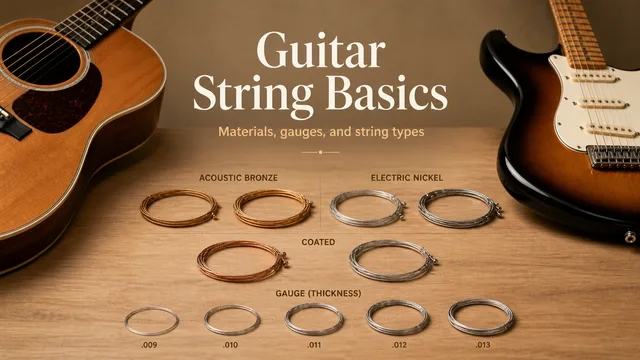
The note names are the same on acoustic and electric guitar when both are in standard tuning. The fretboard material, string gauge, and pickup system may feel different, but the note map does not change.
Bass guitar uses the same note logic too, but a standard 4-string bass is tuned E, A, D, G from thickest to thinnest. That matches the four lowest strings of a standard guitar, one octave lower.
Simple Practice Drill
Pick one note, such as C. Find every C on the low E and A strings up to the 12th fret. Then do the same with G and D. Those notes show up often as chord roots, so this drill improves both note knowledge and practical playing.
Work slowly. The goal is not to recite the fretboard once. The goal is to find notes quickly enough that they help with chords, scales, and songs.