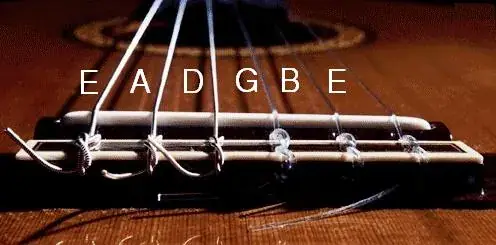
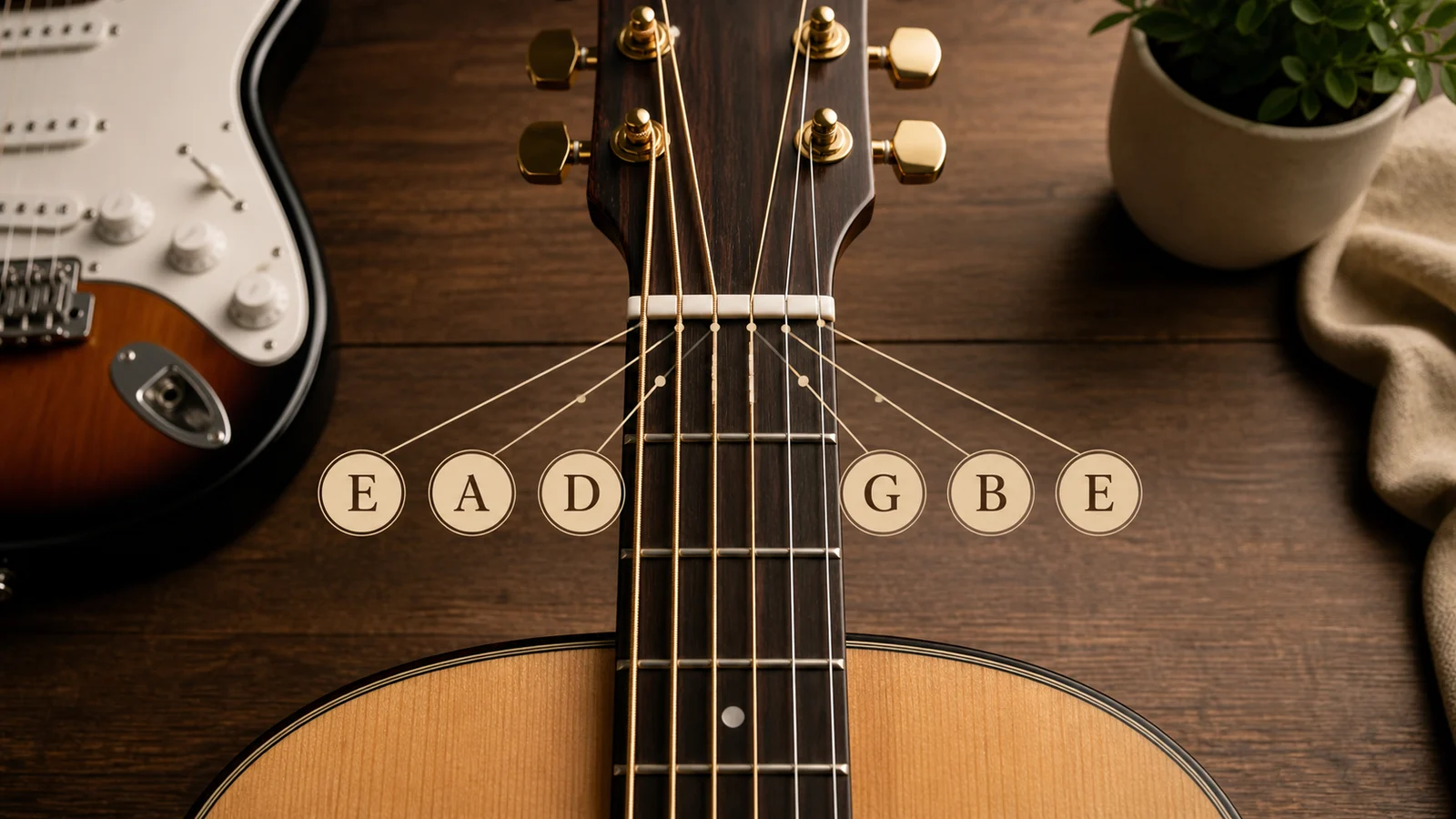
In standard tuning, the six guitar string names from thickest to thinnest are E, A, D, G, B, E.
The numbering goes the other direction: string 1 is the thinnest high E string, and string 6 is the thickest low E string.
That numbering is the part that confuses many beginners. The string closest to your face when you hold the guitar normally is string 6. The string closest to the floor is string 1.
Standard Tuning
From the player’s view:
- String 6: low E
- String 5: A
- String 4: D
- String 3: G
- String 2: B
- String 1: high E
You may also see the same order written from thinnest to thickest: E, B, G, D, A, E. That is not a different tuning. It is just the reverse direction.
Why Names Matter
String names help you tune, read chord diagrams, follow lessons, and understand fretboard notes. If a lesson says “put your finger on the second fret of the A string,” you need to know that the A string is string 5.
The names also help you troubleshoot tuning. If your tuner says the 5th string is near G sharp, you know it is too low because the 5th string should be A in standard tuning. If the 1st string is near F, it is too high because that string should be high E.
Beginner Tip
Learn both systems: note names and string numbers. They show up in different lessons, tuners, tabs, and setup instructions.
How To Remember The String Names
Use a phrase only as a temporary memory aid. The classic pattern is:
| String | Note | Position |
|---|---|---|
| 6 | E | Thickest, lowest sounding |
| 5 | A | Second thickest |
| 4 | D | Middle-low |
| 3 | G | Middle-high |
| 2 | B | Second thinnest |
| 1 | E | Thinnest, highest sounding |
One common memory phrase is “Every Adult Dog Growls, Barks, Eats.” It follows the thickest-to-thinnest order: E, A, D, G, B, E.
High E vs Low E
Both outside strings are named E, but they are not the same pitch. The 6th string is the low E. The 1st string is the high E. If a teacher says “play the E string,” listen for whether they mean low E or high E.
When in doubt, use the string number. “6th string E” means the thick string. “1st string E” means the thin string.
Left-Handed Guitars
The string names do not change for a left-handed guitar in standard tuning. The physical direction may feel reversed when you look at the instrument, but standard tuning is still E, A, D, G, B, E from the lowest-sounding string to the highest-sounding string.
Quick Test
Point to a random string, say its number, then say its note name. Do this for one minute before practice. It is a small habit, but it makes chord diagrams and fretboard lessons much easier to follow.