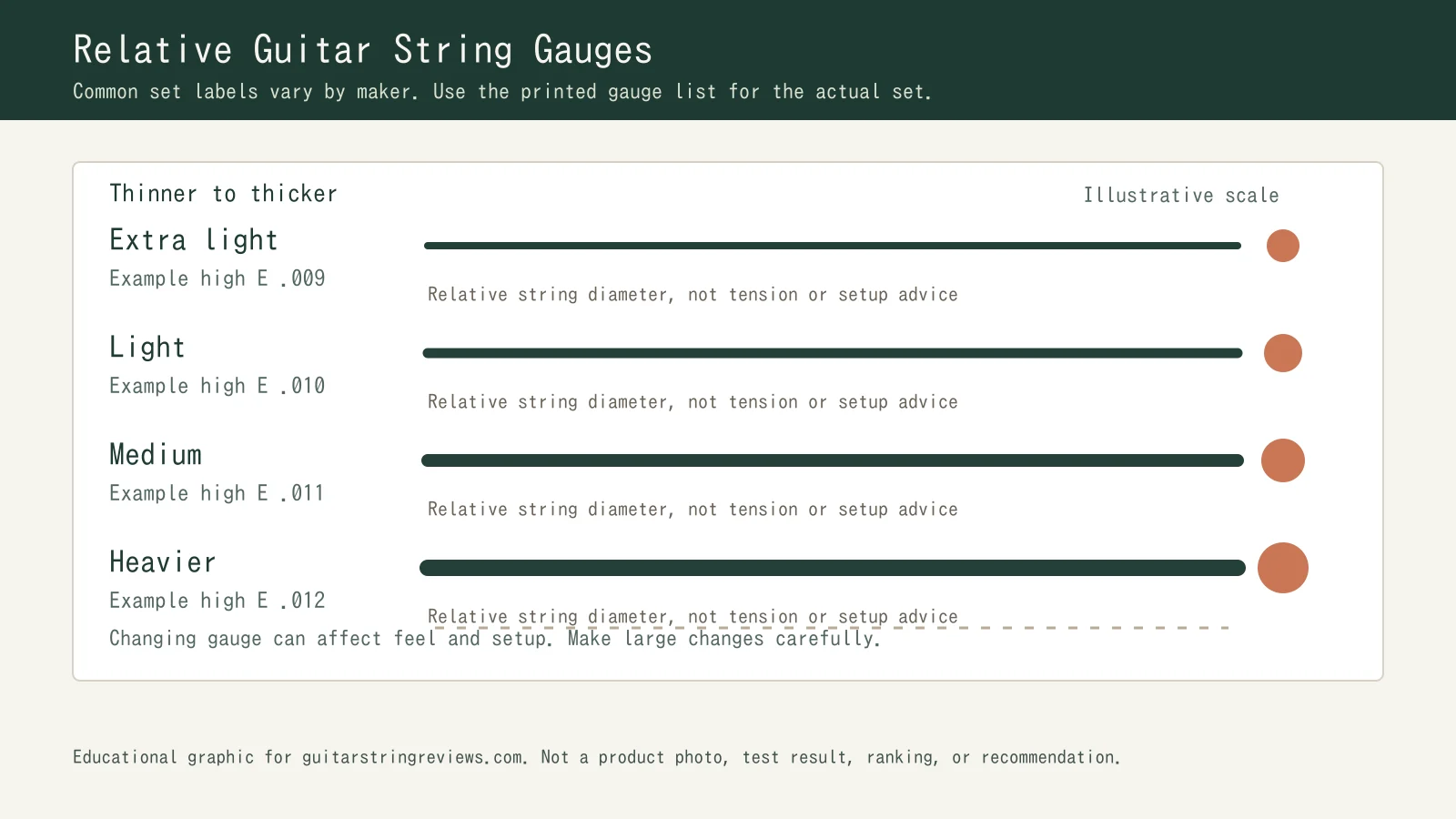
Guitar string gauge is the thickness of a string, usually shown as a number such as .009, .010, .011, or .012. A set labeled ”10s” or “10-46” usually means the thinnest string is .010 inches, with the remaining strings matched into a set. Gauge affects how a string feels under the fingers, how much tension it may carry at pitch, and whether the guitar still feels right after a change.
There is no single gauge that fits every guitarist, guitar, tuning, or playing style. Start by matching the gauge to your instrument type, tuning, current setup, and the feel you want. If you are unsure, make changes gradually.
What String Gauge Means
Gauge describes string thickness. Higher gauge numbers mean thicker strings, while lower gauge numbers mean thinner strings. On electric guitar, common set names often refer to the high E string: a .009 set may be called “9s,” a .010 set may be called ”10s,” and a .011 set may be called ”11s.”
Acoustic sets are often described with words such as extra light, custom light, light, medium, or heavy, depending on the manufacturer. Those words are helpful labels, but the actual gauges printed on the pack matter more than the category name alone.
Light, Medium, And Heavier Sets
Lighter gauge strings are thinner. Manufacturer guidance commonly presents lighter sets as lower-tension options compared with heavier sets at the same tuning and scale length. Some players choose lighter sets when they want less resistance for fretting or bending, but that does not mean a lighter set is automatically the right choice for every beginner, hand size, genre, or guitar.
Medium and heavier sets use thicker strings. They may feel firmer under the fingers and may be chosen for reasons such as tuning preference, instrument response, or a player’s desired feel. Heavier strings can also change the way a guitar responds, so they should be treated as a setup-sensitive change rather than a casual swap on every instrument.
Electric Guitar Gauge Considerations
Electric guitar sets often start around familiar labels such as 9s, 10s, or 11s, though the exact gauges vary by set. A player using standard tuning on one guitar may prefer a different feel than a player using another tuning, scale length, or playing approach.
When changing electric string gauge, consider:
- The guitar’s current setup and action
- Tuning and whether it differs from standard tuning
- How much resistance you want when fretting or bending
- Whether the nut slots, bridge, or tremolo system may need attention after a gauge change
- Whether you are changing one step or making a larger jump
If a guitar has a floating tremolo, very low action, or a setup that is already sensitive, a gauge change can be more noticeable. In that case, a setup check is part of the decision, not an afterthought.
Acoustic Guitar Gauge Considerations
Acoustic guitars are often more physically responsive to string gauge because the strings drive the top of the guitar. Manufacturer guidance commonly presents lighter acoustic sets as an option for players who want less string tension, while medium or heavier sets may be chosen for a firmer feel or a different response from the instrument.
The right acoustic choice depends on the guitar, the player’s tuning, and the manufacturer guidance for that instrument. Some acoustic guitars may not be intended for every heavy-gauge or altered-tuning setup. If the guitar is older, lightly built, or already has setup concerns, check the instrument maker’s guidance or a qualified repair person before making a large gauge change.
A Practical Gauge Choice Framework
Use this sequence when choosing a starting gauge:
- Start with the gauge already on the guitar if it plays well and stays in tune for your needs.
- Check the guitar maker’s guidance if you are unsure what the instrument is designed to handle.
- Change gradually when possible, such as moving from 9s to 10s or from light acoustic to a nearby set.
- Treat tuning changes as part of the gauge decision.
- Plan for a setup check if the guitar feels different after the change.
- Reevaluate by feel, tuning behavior, and string condition after you have played the new set.
That keeps the decision tied to the guitar in front of you, instead of treating gauge as a universal rule.
Gauge, Coating, And String Changes Are Separate Decisions
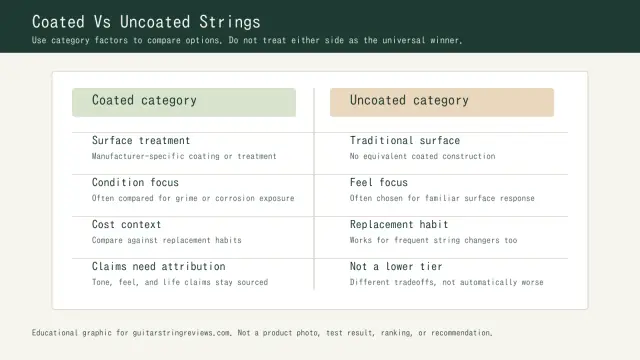
Gauge is only one part of a string set. Material, construction, and coating can also affect the buying decision, but they answer different questions. Gauge is mainly about thickness and feel. Coating is about whether the string uses a protective coating or treatment. Replacement timing comes down to condition, sound preference, playing frequency, and environment.
For those related decisions, see:
Sources Used
Sources consulted for gauge and string-choice context: D’Addario tension chart, D’Addario String Finder, Ernie Ball electric guitar strings, Ernie Ball string gauge guide, Fender beginner guitar FAQ, and Martin guitar string gauge guidance. Brand language around tone, feel, setup, and tension is treated as guidance to compare, not as a guaranteed result.